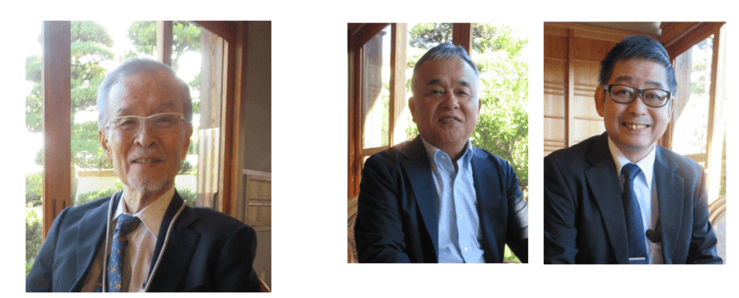
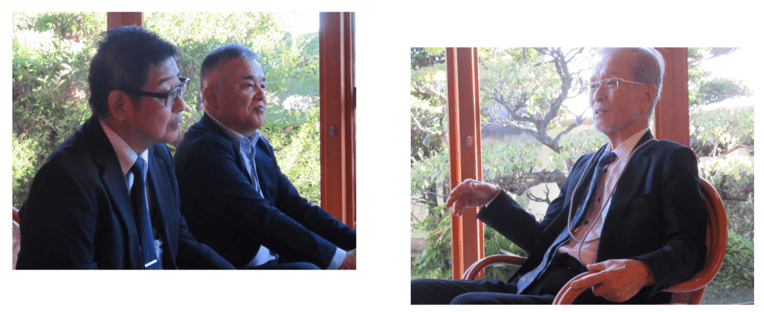
Professor of Chubu University: Hisashi Yamamoto
vs. Tosoh Finechem Co., Ltd. Representative Director, President: Hisao Eguchi
Director of Research and Development Division: Noritaka Nagasaki
1. The appeal of organoaluminum
Nagasaki: Tosoh Finechem Co., Ltd. was established in 1965 as Toyo Stauffer Chemical Co., Ltd., a joint venture between Toyo Soda Manufacturing Co., Ltd. and Stauffer Chemical in the United States. In 1969, we began producing organoaluminum (alkylaluminum) compounds, embarking on our path as a supplier of catalyst raw materials for polyolefins and synthetic rubber, and have grown together with Japan’s polyolefin industry ever since.
Professor Yamamoto, you assumed a position as an assistant in Professor Nozaki’s laboratory at Kyoto University in 1972, later served as an associate professor at the University of Hawaii, and after moving to Nagoya University in 1980, your research into designer Lewis acid catalysts flourished.
Our connection with Professor Yamamoto dates back to the 1980s, when we dispatched a sponsored researcher to your laboratory to study applications of organoaluminum compounds; that relationship has continued to the present day.
Among the Lewis acid catalysts that are the focus of the your research, organoaluminum compounds occupy a central position. Please enlighten us again on the fascinating aspects of organoaluminum chemistry.
Prof. Yamamoto: My first use of organoaluminum dates back to when I was an assistant under Professor Nozaki at Kyoto University. At the time, I was extending my research beyond reactions using butyllithium, and I distinctly remember Professor Nozaki expressing considerable concern about the safety of organoaluminum compounds. In actual handling, I felt that when diluted to the same concentration, organoaluminum compounds pose almost the same level of hazard as butyllithium. What makes organoaluminum (alkylaluminum) particularly interesting is that it has three alkyl groups that can be transformed.
For example, mixing 2,6-di-tert-butylphenol with trimethylaluminum (TMAL) generates methane gas and produces a very bulky Lewis acid in which the phenolic moiety is bound to aluminum. The aluminum center is inherently strongly Lewis acidic, so even though it is bulky, it functions robustly as a Lewis acid. What remains vividly in my memory is that when this bulky Lewis acid was applied to benzaldehyde and then reacted with a nucleophile, the more reactive aldehyde group was blocked by coordination to the Lewis acid and did not participate, while the para position of the benzene ring, activated by this coordination, underwent a beautiful nucleophilic addition. At the time this was an entirely new reaction. In other words, the appeal of organoaluminum lies in enabling achievements no one had previously accomplished. This discovery led to research on designer Lewis acid catalysts, making possible high levels of stereoselectivity and molecular recognition unattainable with conventional Lewis acids.
Eguchi: I feel a deep affinity in hearing that trimethylaluminum (TMAL) was the starting point for your designer Lewis acid catalyst research. Organoaluminum compounds like TMAL require sophisticated handling know-how even for us as manufacturers, yet you focused on their characteristics and built a new field of chemistry, and I would like to express renewed respect for that.
In 2025, our company will mark the 60th anniversary of its establishment. In the run-up to this, we realized our long-cherished goal of in-house production of TMAL and established an integrated production system from TMAL to methylaluminoxane (MAO). This TMAL facility is characterized by an original, highly efficient production process. Process research did not proceed as initially envisioned; after numerous changes in direction, we arrived at the current method. Along the way, your advice, which involved a shift in thinking, provided the impetus for a major breakthrough.
Prof. Yamamoto: Your TMAL/MAO project was new in every aspect. With the aim of an original manufacturing method, you carefully addressed and solved challenges one by one. From the outside it may look as though you simply built a plant, but there are many elements that were perfected within the technical domain of organoaluminum chemistry. In that sense, as I consulted with your young researchers, I found our discussions very interesting.
Publishing papers is wonderful, but the depth of technology built by manufacturers through accumulated know-how is of a different nature. What is routine for your company is in fact not routine; there are many things only your company knows. On the other hand, properly documenting such technical achievements is very important for passing technology on to future generations and for recognizing the achievements of young researchers.
Recognition of results is important within the company, but it can also become the seed of collaborative research from outside the company. For example, I think your company could aim for awards from academic societies.
2. Application to peptide synthesis
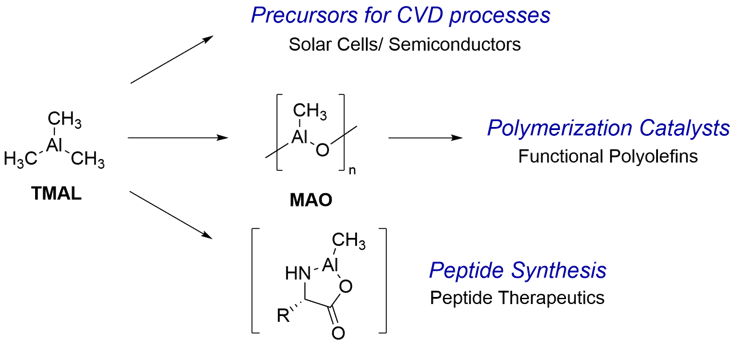
Nagasaki: TMAL has the simplest molecular structure among organoaluminum compounds, yet it exhibits unique properties and functions not found in other organoaluminum species. Examples include MAO as a cocatalyst for polymerization and precursors for CVD processes in semiconductors and solar cells.
Meanwhile, Professor Yamamoto has been exploring the use of TMAL as a reagent in peptide synthesis, which is said to be the mainstay of next-generation pharmaceuticals. It is a very intriguing study. Please tell us more about the concept.
Prof. Yamamoto: Peptide therapeutics are extraordinarily expensive to manufacture and have not yet become sufficiently widespread globally. If we can make them cheaper, I believe Japan can surely take the lead in global drug discovery. I want to achieve this dream through an All-Japan effort.
However, doing so requires changing the way we approach organic chemistry. That is, rather than focusing on just a single functional group as before, we need to focus on two or three functional groups and comprehensively convert everything into different compounds. This is not an easy task.
TMAL may play an important role here. Despite being a small molecule, it can engage systems that bind and react with two or more functional groups and convert them into products. Specifically, pre-reacting an unprotected amino acid with TMAL to form a five-membered ring intermediate allows it to react smoothly with a nucleophilic amino acid ester to give a dipeptide. By further adding amino acids and TMAL in sequence, the peptide can be elongated stepwise. This simple and efficient reaction system enables one-pot peptide synthesis without the need for expensive coupling reagents (T. Hattori, H. Yamamoto, Chem. Sci., 2023, 14, 5795–5801). This chemistry has only just begun, but I believe it will expand from here.
Eguchi: It is astonishing that a highly reactive compound like TMAL can be used in peptide synthesis, and I think this is an idea that only someone who developed designer Lewis acid catalysts would conceive.
Our company is a TMAL manufacturer, and at the same time we are an experienced TMAL user equipped with facilities and technologies to handle TMAL safely. As TMAL-driven peptide synthesis moves toward practical application, we hope to help as part of an All-Japan effort.
3. Toward future Japan-style innovation
Nagasaki: Lastly, for Japanese researchers including ourselves, please share your thoughts on the mindset needed to create innovation, taking into account characteristics typical of Japanese people.
Prof. Yamamoto: There are two kinds of innovation. One is disruptive innovation, where new products suddenly take over, as silver halide photography was quickly replaced by digital photography. The other is sustaining innovation, where product levels are gradually improved. In corporate R&D, sustaining innovation is of course important, but it would extend corporate longevity if there were also research themes aimed at disruptive innovation, even if only a few percent of the portfolio.
Studies that classify the world’s ethnic groups describe Japanese as introverted, intuitive, and feeling-oriented, said to be unique among roughly 150 ethnic groups. I believe the Japanese strengths in feeling and sense can lead to success in science and technology and are inherently well-suited to disruptive innovation.
Japan has a culture of entering through the form. In tea ceremony, flower arrangement, judo, kendo, and archery, you begin with form. Explanations of why certain movements are necessary are omitted, and only after years do you come to understand the reasons. This Japanese culture has greatly influenced the development of Japanese science and technology. By listening to the voice of nature and tracing back to natural principles, we can approach truth, and this often leads to serendipity.
On the other hand, Japan also has the notion of "tonari-byakushou". If the neighbor sows seeds, you sow seeds; if the neighbor harvests rice, you harvest rice. In this way one can live life without major trouble. But this cannot produce disruptive innovation that moves the world. Japan once had an era of repeated disruptive innovation that took the world by storm, such as in steelmaking, shipbuilding, and products like the WALKMAN®. It is said this was because Tokyo was reduced to ashes after the war, and with nothing left to imitate.
I think it is fine to spend two or three years finding problems for research themes that bring disruptive innovation. The important thing is to keep thinking. In extreme terms, you need to keep thinking even while you sleep. And at times, gaze idly at the theme. Alternating between concentration and defocus is the trick to generating wonderful ideas. I hope we will leverage Japanese strengths of feeling and sense to pursue science and technology that can sweep the world. I have great expectations for the younger generation of researchers.
Hisashi Yamamoto
Professor and Director, Molecular Catalyst Research Center, Chubu University
Professor Emeritus, The University of Chicago
Professor Emeritus, Nagoya University
He was born in Kobe, Japan, earned a B.S. at Kyoto University in 1967 and a Ph.D. at Harvard University in 1971.
Academic Career
1971-1972 Researcher, Toray Industries, Inc. (Prof. J. Tsuji, Adviser)
1972-1976 Instructor, Kyoto University (Prof. H. Nozaki, Adviser)
1976-1977 Lecturer, Kyoto University
1977-1980 Associate Professor, University of Hawaii
1980-1983 Associate Professor, Nagoya University
1983-2002 Professor, Nagoya University
2002-2012 Professor, The University of Chicago
2012- Professor and Director of Molecular Catalyst Research Center, Chubu University
2016-2018 President of Chemical Society of Japan
- SHARE

- Tweet
